
Friday, June 20, 2008
There's a rabbit on my ceiling, no, wait--it's a fish...
"Lying in bed would be an altogether perfect experience if only one had a colored pencil long enough to draw on the ceiling." G.K. Chesterson


Tuesday, June 17, 2008
Art as a Cultural Force
The following article was first published earlier this year in our school newsletter. I teach at a private Christian school and this article reflects my faith as well as my opinions about art. But since it's my blog, you probably figured that part. :-)
------------------------------
“Humanity looks to works of art to shed light upon its path and its destiny.” —Pope John Paul II
As I learn more about the history of art I am constantly surprised by what an important role art has played in culture throughout history. Sometimes art has reflected the culture and sometimes art has shaped the culture. For instance, art in the French Rococo-style is ornate, with fine details and frivolous, frequently immoral subject matter. This art was created for the nobility and upper echelons and reflected their culture, while ignoring the world of the everyday people. When the revolution swept through, not only did the government and social structures change, artistic styles and subject matter underwent a revolution of their own, too. Gone were the highly decorative images of the court, replaced, instead, by the clean lines and noble themes of Neoclassicism. It would be easy to dismiss these changes as the fickle fads of fashion, but a look deeper shows that some artists were in a role of shaping culture at these pivotal times.
A good example of this situation is Jacques–Louis David, who painted many images promoting the revolutionary cause. His most famous is The Oath of the Horatii, which exalted the sacrifice of self for the state. David went on to become the official painter for Napoleon and his masterful Napoleon Crossing the Alps is a classic example of art as political propaganda. The painting shows Napoleon on a powerful, rearing steed with his beleaguered troops moving behind him (there are four versions of the painting, with slightly varying names and horses, but all show the same scene). In the foreground the rocks are carved with the names of Charlemagne, Hannibal and Napoleon himself, to forge a link in the viewer's mind between the great generals of the past and Napoleon. In fact, he crossed the Alps several days after his troops on a donkey.
  Even after Napoleon fell from power and David was forced into exile, he still exhorted his artistic followers to use their art to restore the glory of the Republic.
The influence of art and its use as propaganda was not lost on another famous tyrant. Robert Edsel's fascinating book Rescuing da Vinci tells the story of Hitler's infamous taste for art and the allied Monument Men, who were given the task of sorting out and returning Nazi loot after the war ended. Hitler wanted to be an artist, and he took his rejection by the Vienna Academy of Fine Arts very personally. His disappointment rapidly grew into bitterness and he developed a plan to create the finest art museum possible in his hometown of Linz, Austria as a way to humiliate the Vienna Academy. As his armies invaded a country, Hitler's staff had lists of art pieces to send back to Germany to eventually be placed into this museum. Not all pieces of art were the same in Hitler's opinion, though, and art that he did not understand or like was deemed “Degenerate Art” and either sold to raise money for weapons or destroyed (at these times when an air of respectability was needed for resale, he changed the laws to strip people of their citizenship and property rights so that the state's commandeering of art objects didn't appear to be outright theft; very little money was actually raised by these sales). Museums and galleries across the continent closed and began hiding their art treasures.
Hitler also saw the value of these art pieces as propaganda, however, and made a show of destroying art created by artists whose ethnic or cultural heritage was “undesirable” to further promote his own twisted plans. For example, the cultural treasures of Warsaw, Poland were demolished because the people were of Slavic origin, while the cultural treasures of Cracow, Poland were not because the people were considered of Germanic origin. When the Allies began to make their way through Italy, Hitler used their initial ignorance of the importance of preserving art and architectural monuments against them, casting Americans as barbarians eager to sack and pillage European culture. Once the Allies realized the damage being done they went to great pains to preserve these treasures, although mistakes sometimes still happened. An errant Allied bomb destroyed most of the Santa Maria delle Grazie, better known as the home of Leonardo da Vinci's The Last Supper fresco. The fresco wall survived because it had been encased in sandbags held in place by scaffolding and wood planks.
In our own time art is still a powerful cultural force, although its appearance may not be as refined as previous centuries. Unfortunately much Christian influence has been lost in the arts in the modern era, and when Christian imagery is used it is frequently meant to be divisive and controversial, or used for shock value to make a quick name for the artist. Much of what is new and considered chic in the fine art world is based on shock value. I've seen several such examples in the same institutions that house world-famous paintings. At one of our country's finest art institutions, not only did I see paintings by Guercino, Monet, Seurat, Whistler and Cassat (to name just a few), but also a bar of used soap decorated with a spiral of hair. I guess it was hip or something—I just wondered how much they paid for it and who was the bigger fool (professing themselves wise...). The famous American novelist Edith Wharton once said “Another unsettling element in modern art is that common symptom of immaturity, the dread of doing what has been done before.” Since she died in 1937, she must have been referring to early 20th-century art and had no idea how much stranger art could get.
As discouraging as the state of most modern art can be, though, I like to remember that all things in our world can be redeemed through the power of our Savior. As Christians we need not fear art, but learn to “take captive every thought to make it obedient to Christ.” ( II Corinthians 10:5 ) and “See to it that no one takes you captive through hollow and deceptive philosophy, which depends on human tradition and the basic principles of this world rather than on Christ.” (Colossians 2:8 ) So rather than focus on the dismal state of much of modern art, I like to think of the opportunity we have to grow up a generation of artists who desire to glorify God in our culture—and that is a marvelous destiny indeed.
------------------------------
“Humanity looks to works of art to shed light upon its path and its destiny.” —Pope John Paul II
As I learn more about the history of art I am constantly surprised by what an important role art has played in culture throughout history. Sometimes art has reflected the culture and sometimes art has shaped the culture. For instance, art in the French Rococo-style is ornate, with fine details and frivolous, frequently immoral subject matter. This art was created for the nobility and upper echelons and reflected their culture, while ignoring the world of the everyday people. When the revolution swept through, not only did the government and social structures change, artistic styles and subject matter underwent a revolution of their own, too. Gone were the highly decorative images of the court, replaced, instead, by the clean lines and noble themes of Neoclassicism. It would be easy to dismiss these changes as the fickle fads of fashion, but a look deeper shows that some artists were in a role of shaping culture at these pivotal times.
A good example of this situation is Jacques–Louis David, who painted many images
 promoting the revolutionary cause. His most famous is The Oath of the Horatii, which exalted the sacrifice of self for the state. David went on to become the official painter for Napoleon and his masterful Napoleon Crossing the Alps is a classic example of art as political propaganda. The painting shows Napoleon on a powerful, rearing steed with his beleaguered troops moving behind him (there are four versions of the painting, with slightly varying names and horses, but all show the same scene). In the foreground the rocks are carved with the names of Charlemagne, Hannibal and Napoleon himself, to forge a link in the viewer's mind between the great generals of the past and Napoleon. In fact, he crossed the Alps several days after his troops on a donkey.
  Even after Napoleon fell from power and David was forced into exile, he still exhorted his artistic followers to use their art to restore the glory of the Republic.
The influence of art and its use as propaganda was not lost on another famous tyrant. Robert Edsel's fascinating book Rescuing da Vinci tells the story of Hitler's infamous taste for art and the allied Monument Men, who were given the task of sorting out and returning Nazi loot after the war ended. Hitler wanted to be an artist, and he took his rejection by the Vienna Academy of Fine Arts very personally. His disappointment rapidly grew into bitterness and he developed a plan to create the finest art museum possible in his hometown of Linz, Austria as a way to humiliate the Vienna Academy. As his armies invaded a country, Hitler's staff had lists of art pieces to send back to Germany to eventually be placed into this museum. Not all pieces of art were the same in Hitler's opinion, though, and art that he did not understand or like was deemed “Degenerate Art” and either sold to raise money for weapons or destroyed (at these times when an air of respectability was needed for resale, he changed the laws to strip people of their citizenship and property rights so that the state's commandeering of art objects didn't appear to be outright theft; very little money was actually raised by these sales). Museums and galleries across the continent closed and began hiding their art treasures.
Hitler also saw the value of these art pieces as propaganda, however, and made a show of destroying art created by artists whose ethnic or cultural heritage was “undesirable” to further promote his own twisted plans. For example, the cultural treasures of Warsaw, Poland were demolished because the people were of Slavic origin, while the cultural treasures of Cracow, Poland were not because the people were considered of Germanic origin. When the Allies began to make their way through Italy, Hitler used their initial ignorance of the importance of preserving art and architectural monuments against them, casting Americans as barbarians eager
 to sack and pillage European culture. Once the Allies realized the damage being done they went to great pains to preserve these treasures, although mistakes sometimes still happened. An errant Allied bomb destroyed most of the Santa Maria delle Grazie, better known as the home of Leonardo da Vinci's The Last Supper fresco. The fresco wall survived because it had been encased in sandbags held in place by scaffolding and wood planks.
 In our own time art is still a powerful cultural force, although its appearance may not be as refined as previous centuries. Unfortunately much Christian influence has been lost in the arts in the modern era, and when Christian imagery is used it is frequently meant to be divisive and controversial, or used for shock value to make a quick name for the artist. Much of what is new and considered chic in the fine art world is based on shock value. I've seen several such examples in the same institutions that house world-famous paintings. At one of our country's finest art institutions, not only did I see paintings by Guercino, Monet, Seurat, Whistler and Cassat (to name just a few), but also a bar of used soap decorated with a spiral of hair. I guess it was hip or something—I just wondered how much they paid for it and who was the bigger fool (professing themselves wise...). The famous American novelist Edith Wharton once said “Another unsettling element in modern art is that common symptom of immaturity, the dread of doing what has been done before.” Since she died in 1937, she must have been referring to early 20th-century art and had no idea how much stranger art could get.
As discouraging as the state of most modern art can be, though, I like to remember that all things in our world can be redeemed through the power of our Savior. As Christians we need not fear art, but learn to “take captive every thought to make it obedient to Christ.” ( II Corinthians 10:5 ) and “See to it that no one takes you captive through hollow and deceptive philosophy, which depends on human tradition and the basic principles of this world rather than on Christ.” (Colossians 2:8 ) So rather than focus on the dismal state of much of modern art, I like to think of the opportunity we have to grow up a generation of artists who desire to glorify God in our culture—and that is a marvelous destiny indeed.
Thursday, May 22, 2008
Joy of Joys
Oh joy of joys! Oh sweet delight!
It's teacher appreciation week and yesterday I came in to a lovely card and a gift certificate to the local art supply store! Red rubber blocks, here I come! (See previous post.)
This has been such a nice week. Want to hear a funny story on me? Last week I was under the impression it was teacher appreciation, so I took all our teachers their gifts. (See the fresco pictures in my last post for the gift to our fourth grade teacher. I gave him the cross fresco I made for his classroom.) But on Friday at the end of the day I still had not even had anyone tell me "Happy appreciation week." I was so bummed out. I kept telling myself that it didn't matter, but you know those two little voices? The other one kept saying things like "Well, you're so strict and mean with those 7th and 8th graders--they don't like you. Why would they appreciate you? You give TESTS in ART! I mean what kind of art teacher does that?!" Well, I do. I want to make sure they're listening and learning.
Well, by the time my poor husband came home I was checked out on the couch playing video games, trying not to cry between planets. Then it all came spewing out. It really showed me the condition of my heart and it came up wanting. I don't teach so that everyone can tell me what a great job--well good job--okay any kind of praise is nice--I do. I teach to help the school, to encourage budding artists, to expose the kids to an element of our created being in God's image (the creativity), to share what I've learned and the side benefits include growing my own skills, being around children that I enjoy and love and promoting art in as many forms as possible. But last Friday it didn't feel that way, until after I let go of all the selfishness. Heart check.
Then I went in the kitchen and as I was cleaning it up something kept niggling the edge of my brain. Something about a letter I'd received asking for help with appreciating my son's teacher. Something about the 19th of May. It didn't take long for me to dig up the letter and yes, it did say something about the 19th of May. It said that was the beginning of, yes, you guessed it--teacher appreciation week. What else could I do but laugh at my own foolishness? I am such an idiot.
So between feeling really foolish and getting a close up view of the state of my heart lately, this week has been humbling. I've received three gifts this week, each one very thoughtful, and each one has reminded me that I'm not that deserving. I don't teach to receive glory, but that is what I was wanting. I am humbled and that is how God wants me, but He loves me even when I mess up--I really like that part. Even when my heart is not where He wants it, He still sacrificed for me and He doesn't lose His sheep. If you're not one of His sheep and have questions, please send me a comment/message--I'd love to share with you. If you are one of His sheep--that's really the Joy of Joys and the Sweetest Delight--don't you think!
Gloria!
It's teacher appreciation week and yesterday I came in to a lovely card and a gift certificate to the local art supply store! Red rubber blocks, here I come! (See previous post.)
This has been such a nice week. Want to hear a funny story on me? Last week I was under the impression it was teacher appreciation, so I took all our teachers their gifts. (See the fresco pictures in my last post for the gift to our fourth grade teacher. I gave him the cross fresco I made for his classroom.) But on Friday at the end of the day I still had not even had anyone tell me "Happy appreciation week." I was so bummed out. I kept telling myself that it didn't matter, but you know those two little voices? The other one kept saying things like "Well, you're so strict and mean with those 7th and 8th graders--they don't like you. Why would they appreciate you? You give TESTS in ART! I mean what kind of art teacher does that?!" Well, I do. I want to make sure they're listening and learning.
Well, by the time my poor husband came home I was checked out on the couch playing video games, trying not to cry between planets. Then it all came spewing out. It really showed me the condition of my heart and it came up wanting. I don't teach so that everyone can tell me what a great job--well good job--okay any kind of praise is nice--I do. I teach to help the school, to encourage budding artists, to expose the kids to an element of our created being in God's image (the creativity), to share what I've learned and the side benefits include growing my own skills, being around children that I enjoy and love and promoting art in as many forms as possible. But last Friday it didn't feel that way, until after I let go of all the selfishness. Heart check.
Then I went in the kitchen and as I was cleaning it up something kept niggling the edge of my brain. Something about a letter I'd received asking for help with appreciating my son's teacher. Something about the 19th of May. It didn't take long for me to dig up the letter and yes, it did say something about the 19th of May. It said that was the beginning of, yes, you guessed it--teacher appreciation week. What else could I do but laugh at my own foolishness? I am such an idiot.
So between feeling really foolish and getting a close up view of the state of my heart lately, this week has been humbling. I've received three gifts this week, each one very thoughtful, and each one has reminded me that I'm not that deserving. I don't teach to receive glory, but that is what I was wanting. I am humbled and that is how God wants me, but He loves me even when I mess up--I really like that part. Even when my heart is not where He wants it, He still sacrificed for me and He doesn't lose His sheep. If you're not one of His sheep and have questions, please send me a comment/message--I'd love to share with you. If you are one of His sheep--that's really the Joy of Joys and the Sweetest Delight--don't you think!
Gloria!
Tuesday, May 20, 2008
Out of disaster, or, it all began with an eraser
Our fourth grade spends their year studying the Middle Ages through the Reformation for their history section. Since I try to plan my art lessons around their history when I can, fourth grade has been an awesome art year. We looked at some art history, we made some frescoes, we studied cathedral and castle architecture, we designed illuminated letters and we played with calligraphy. We learned about concepts like simultaneous narrative, and how to understand it in a painting, and how still lifes became popular. We looked at some popular subject matter and tried it for ourselves with St. George and the dragon. And when we came to Gutenberg we tried our hand at printing.
 From which came one of our few art disasters this year. In third grade it was carving plaster; in fourth grade it was woodblock printing. Don't get me wrong--we learn through our less-than-perfect results. Even the masters had disasters--just look at Leondardo's The Last Supper fresco, which was already deteriorating during his own lifetime because he experimented with oil in the fresco (Bad choice there!). Not every art project is going to come out perfect, no matter how well you plan.
And I did quite a bit of planning with the woodblock printing project. My kindergartener proved that the wood blocks could be indented with a ball point, but the fourth-graders did not prove so hardy, and my own acrylics turned out to be much thicker than the school's tempera. Which equalled disastrous results. C'est la vie.

However, since the printed pages were meant to be part of our Book of Hours project, it was hard for me to let go. With so few pages already going in the book, having one more missing felt extra-discouraging. Enter the grand idea. You know about grand ideas, don't you? The ones that seem so good when they enter the brain; so right that how could anything go wrong? I would just carve my own woodblock and make prints for the kids.
Okay, have you ever carved a woodblock? They don't go real fast. The weeks--no more like months--it would take stretched out in my mind and I tried thinking of other solutions. Wait, a friend gave me a heat tool for Christmas. Surely burning would go faster. Nope! Exchanging a blade for fire was not a good thing.
Now that the year is rapidly coming to an end, it became crucial that I either find
a solution or abandon the project. But how to let go of Gutenberg when movable type changed the world?! (Don't you love hyperbole.) With only a few days left before we need to think about binding our books, I made the decision. The supple block of rubber that I've been hoarding would work just right. And in one night--from drawing to carved--it was done! Now I just have to print them.
If you've never tried carving out your own stamps, I highly recommend it. Being a person with way too many disparate supplies and far too many ideas, I had resisted the interest I felt whenever I read about people carving their own stamps. Earlier this year I gave in when I needed a small bird stamp for some inchies. Taking out an extra eraser I drew my little image and then made the first cut. My co-workers used to tease me about being the keeper of the knives (at every job one of my first requests was a box-knife--I mean have you ever tried cutting mat board with scissors?), and I guess there was more to it than I realized, because that first cut sealed the deal. My exacto blade went through the plastic so nicely. Three birds, two asterisks and one word later my eye fell on a pink pearl... I hate pink pearl erasers; they are the destroyers of too many pieces of art. Being of petroleum origin, when old the oils come to the surface and the unknowing art student puts them to paper and bam! Ruined! A nice oil stain in place of your graphite. So what better use for a pink pearl than life as a rubber stamp--depositing far more pleasant things on a piece of paper. Ha!
By now I've replaced the exacto with a small carving kit and had purchased a nice piece of rubber that was destined for a bunch of smaller stamps. Oh well, I guess I have to go back to the art store now. Please, don't cry for me--I can make the sacrifice! It is teacher appreciation week at our school, maybe I'll be blessed with a gift certificate. (Yesterday I was blessed with a set of beautiful markers--I can't wait for school to get out so I can play!)
But school isn't over yet, so I'd best get back to the world of art history and Gutenberg. Now, if I can just find the table underneath all this plaster and burlap, paper, fabric, markers...
 Separate note: The extra photos are our frescoes. The Madonna image was done after a Byzantine image to show the kids what we were doing. However, they all made crosses, based after the cross fresco on the table underneath the Madonna. I made it in true fresco fashion, by mixing pigments into very watery plaster and painting them onto the wet plaster. Very interesting and intriguing process. Another medium I could get very distracted by.
 From which came one of our few art disasters this year. In third grade it was carving plaster; in fourth grade it was woodblock printing. Don't get me wrong--we learn through our less-than-perfect results. Even the masters had disasters--just look at Leondardo's The Last Supper fresco, which was already deteriorating during his own lifetime because he experimented with oil in the fresco (Bad choice there!). Not every art project is going to come out perfect, no matter how well you plan.
And I did quite a bit of planning with the woodblock printing project. My kindergartener proved that the wood blocks could be indented with a ball point, but the fourth-graders did not prove so hardy, and my own acrylics turned out to be much thicker than the school's tempera. Which equalled disastrous results. C'est la vie.


However, since the printed pages were meant to be part of our Book of Hours project, it was hard for me to let go. With so few pages already going in the book, having one more missing felt extra-discouraging. Enter the grand idea. You know about grand ideas, don't you? The ones that seem so good when they enter the brain; so right that how could anything go wrong? I would just carve my own woodblock and make prints for the kids.
Okay, have you ever carved a woodblock? They don't go real fast. The weeks--no more like months--it would take stretched out in my mind and I tried thinking of other solutions. Wait, a friend gave me a heat tool for Christmas. Surely burning would go faster. Nope! Exchanging a blade for fire was not a good thing.
Now that the year is rapidly coming to an end, it became crucial that I either find

a solution or abandon the project. But how to let go of Gutenberg when movable type changed the world?! (Don't you love hyperbole.) With only a few days left before we need to think about binding our books, I made the decision. The supple block of rubber that I've been hoarding would work just right. And in one night--from drawing to carved--it was done! Now I just have to print them.
If you've never tried carving out your own stamps, I highly recommend it. Being a person with way too many disparate supplies and far too many ideas, I had resisted the interest I felt whenever I read about people carving their own stamps. Earlier this year I gave in when I needed a small bird stamp for some inchies. Taking out an extra eraser I drew my little image and then made the first cut. My co-workers used to tease me about being the keeper of the knives (at every job one of my first requests was a box-knife--I mean have you ever tried cutting mat board with scissors?), and I guess there was more to it than I realized, because that first cut sealed the deal. My exacto blade went through the plastic so nicely. Three birds, two asterisks and one word later my eye fell on a pink pearl... I hate pink pearl erasers; they are the destroyers of too many pieces of art. Being of petroleum origin, when old the oils come to the surface and the unknowing art student puts them to paper and bam! Ruined! A nice oil stain in place of your graphite. So what better use for a pink pearl than life as a rubber stamp--depositing far more pleasant things on a piece of paper. Ha!
By now I've replaced the exacto with a small carving kit and had purchased a nice
 piece of rubber that was destined for a bunch of smaller stamps. Oh well, I guess I have to go back to the art store now. Please, don't cry for me--I can make the sacrifice! It is teacher appreciation week at our school, maybe I'll be blessed with a gift certificate. (Yesterday I was blessed with a set of beautiful markers--I can't wait for school to get out so I can play!)
But school isn't over yet, so I'd best get back to the world of art history and Gutenberg. Now, if I can just find the table underneath all this plaster and burlap, paper, fabric, markers...
 Separate note: The extra photos are our frescoes. The Madonna image was done after a Byzantine image to show the kids what we were doing. However, they all made crosses, based after the cross fresco on the table underneath the Madonna. I made it in true fresco fashion, by mixing pigments into very watery plaster and painting them onto the wet plaster. Very interesting and intriguing process. Another medium I could get very distracted by.
Wednesday, May 14, 2008
The Power of Great Art

Many years ago I spent a day at the Art Institute of Chicago. Among the highlights of my day were seeing Seurat’s Sunday Afternoon on the Island of the Grande Jatte, Picasso’s The Old Guitarist (blue man with a guitar) and Monet’s haystack series.
 But one moment from that day was more powerful than any piece of art and, for me, illustrates the power of art to speak across time, culture and societal barriers.
 As I left one of the rooms a man stopped me. He was a large, burly man, who looked like he should be on a loud motorcycle somewhere or in a logging truck back home, rather than in an art museum, and I was very surprised when he asked me if I was a Christian. Not sure what was coming next, I said yes, then asked why he wanted to know. He led me over to a painting and told me it made him want to cry. Then he asked me why. Why would he want to cry?
Because he had just come face to face with Christ’s sacrifice, depicted by an artist who had painted it almost 350 years before. At 57-3/4 x 87-1/16 inches, Guercino’s The Entombment is a imposing painting showing the placing of Christ’s body into a stone sepulchre. Baroque art is marked by strong lighting and drama, and this
 painting is no different: Mary stands behind Christ’s body, weeping. The strong emotions of the painting greatly affected the man talking to me, and he wanted to know why he couldn’t just walk away from the image. Why did it affect him so greatly? I know we talked about the sacrifice Jesus made for us, but I really don’t remember everything we talked about. But I do know that his visit to the museum that day probably changed the rest of his life.
Such is the power of great art. Notice that I didn’t say just “art”, or “all art”, but “great art”. Of course not even all great art is going to have such a profound effect on our lives as salvation, but great art does have the power to speak of eternal truths, including salvation. While the term masterpiece is frequently used
 to refer to an artist’s greatest accomplishments, it also refers to those pieces that have a voice beyond their own time. The Mona Lisa is a masterpiece because of Leonardo da Vinci’s technical skill in painting it. Delacroix’s Liberty Leading the People is a masterpiece because it speaks to us of the desire for freedom that crosses class lines, which we can understand today as easily as the viewers who saw it during those turbulent times in France. (Indeed, they
  understood it so well that the painting was removed because from its original display because it was considered inflammatory.)
Art, like literature, transcends our own lives and moments in time, sometimes giving us insight that we don’t grasp in our daily tasks. For many centuries from antiquity on, art was primarily tied to the church and used to teach Bible stories and to impress the majesty of the Trinitarian God. During the Renaissance art changed, and subject matter was no longer exclusively religious, but still concerned with matters of the human condition. Unfortunately, many of us are no longer in a position to understand the stories or messages in these pieces of art because so much cultural literacy is lost; but while modern viewers may be stumped by many of the stories and symbols, contemporary viewers would have been familiar with all the references and understood the meanings. With a little understanding of these stories and of the symbols used, we can usually begin to grasp the deeper meanings of many pieces of art. For example, you can usually find Peter in paintings because he carries a key. Luke is many times accompanied by a bull and knowing why there is a bull in the middle of a painting, seemingly out of place, helps make the image less strange.
Last semester I asked my students which of the images we had looked at was their favorite and why. Two pieces stood out above the rest. One was a favorite because of
 the drama and high emotion of the scene (Delaroche’s Execution of Lady Jane Grey, a historical event that several of them were familiar with), which was not a big surprise. The other favorite was a surprise to me, though. Albrecht Durer’s Knight, Death and the Devil is a complex engraving of a knight on horseback passing the figures of death and the devil. Students particularly liked how the knight did not show fear at the other two figures and pointed out that neither do we when we know Christ. They also pointed out the little dog, which represents faithfulness, trotting at the knight’s heels on his journey through life. None of this subject matter had been discussed in class; instead students had been given the tools and they understood the message on their
  own—a message that we encounter in many places in our spiritual walk, to be sure, but what a powerful visual put to an abstract truth. Such is the power of great art
I'm Back?
We've finally figured out the internet thing, but these last couple weeks of school are crammed. Soccer, grades, art history (from Romanticism to Modern), Renaissance day, still lifes and a Book of Hours will all keep me busy until the first week of June. C'est la vie! Once again I am expectant that life will slow down, but when I turn my scope of vision past the end of school I realize that I still have obligations to fulfill even unto the end of June. Was life always this full?
Sometime in the next few days I hope to post an article I wrote for our school newsletter a few weeks ago. I don't want to post it without the accompanying paintings or I'd just stick it up now. Stay tuned...
And yes, the snow here is finally gone! (Still some in the mountains yet.)
Sometime in the next few days I hope to post an article I wrote for our school newsletter a few weeks ago. I don't want to post it without the accompanying paintings or I'd just stick it up now. Stay tuned...
And yes, the snow here is finally gone! (Still some in the mountains yet.)
Friday, April 25, 2008
Working while away
Well, our internet provider debate still is not resolved, but I've been working while away. Giving and correcting tests, updating my art history knowledge from Romanticism on and preparing for next year. With the exception of the horse, which was done as a Christmas gift, here's a sampling of my little art world. And yes, it was still snowing earlier this week, although it's not sticking now, and the flowers are starting to bloom despite it all. God's cycle of life overcomes the temporal weather and I'm so glad--it means we won't have snow forever!

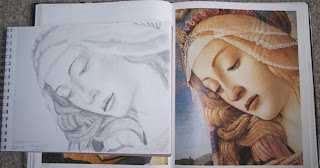
From Botticelli's "Madonna of the Magnificat", this is my drawing, but it is also the next assignment for my students.


A fabric postcard sent to Scotland. I didn't fit in the envelope--c'est la vie.


A Christmas gift for my sister who rides and trains horses, gives lessons and competes in dressage.

A study in colored pencil focusing on values.

The same picture only now being worked in acrylics and experimenting with underpainting.

A gift for a friend in progress.


From Botticelli's "Madonna of the Magnificat", this is my drawing, but it is also the next assignment for my students.


A fabric postcard sent to Scotland. I didn't fit in the envelope--c'est la vie.


A Christmas gift for my sister who rides and trains horses, gives lessons and competes in dressage.

A study in colored pencil focusing on values.

The same picture only now being worked in acrylics and experimenting with underpainting.

A gift for a friend in progress.
Wednesday, April 09, 2008
In a corner of the world far, far away...
I've been away from the computer a lot lately due to internet access problems. I should be back soon... Is it still snowing where you live? It still comes and goes here. This winter is now the second snowiest on record for our area. But my crocus are blooming. Wishing many flowers to you. :-)
Thursday, March 20, 2008
Mirror images
A couple posts back, I asked if anyone knew the two images with incorrect mirrored reflections. The first one, the one my students drew a detail of as part of their test, is Ingres' Madame Moitessier. The students drew her hand on a grid; not a hard project, but it does tell me if they understand the concept. The second image is Manet's Bar at the Folies-Bergerè. If you know of others, feel free to post them in hte comment section.
Sunday, March 16, 2008
Art day

Working on deadline has its advantages. The biggest one that comes to my mind is that the project has to be finished by a specific date. Yes, you're likely thinking, "Well, duh!" Unfortunately I'm one of those people who can easily put a project down and leave it for waaay too long. So as I scratched my head and wondered what projects I could take with me to a teacher crafting get together yesterday, I was very pleased to find a couple small projects that I had put down and--well, you're with me now.
Some good conversation, an awesome cheeseball and five hours later--ta-da! Two finished projects that were both started last summer. (The ATC above was finished quite some time ago and was the inspiration for the lettering on the baby block below.)


Today, in between catching up on grading, I was able to add the finishing touches to a larger flower piece that I am debating putting in my Etsy store. Can I deal with it if it doesn't sell? asks the pessimist. Well, nothing is selling now, so what's the big deal? asks the pragmatist. I'll let you know if I put it there. The base is matboard collaged with calender pages and flower images, then gessoed and painted. The large flowers are painted with acrylics, then highlighted with stamps and water-soluble wax crayons (a favorite supply of mine). The butterfly is cut from a Somerset Studio page (never used one before!). The verse is Genesis 1:11 "And God said, "Let the earth bring forth".


The earth is bringing forth around here, too. I've seen some green grass and the return of robins. One day I listened to the calls of red-winged blackbirds, but they don't stay around our house because we don't have the watery terrain they like. I'll be watching for the first crocus, but it won't be at our house--we still have snow!
Saturday, March 08, 2008
In the spirit of taking our first art test

Oh the joys of teaching! I've been grading tests today, and one of the assigned tasks was to draw a detail from a famous painting on a grid. While looking at the little piece of the painting (24 times!) I pondered one of its elements, which brought to mind a fun little art history trivia question.
The painting we used has a reflection in it and it is one of two famous paintings that have mirrored reflections that are incorrect. Both were done purposely by the individual artists, but neither reflection is realistically possible. Anyone know which two paintings I'm talking about? (BTW, there may be more than two; I only know of these two--but I'm not an expert!)
Here's a hint: they are both 19th century works. Have fun!
And before you go ponder what paintings have mirrors, take a look at this lovely Botticelli, The Madonna of the Magnificat. I spend quite a bit of time looking for paintings that exemplify the concepts I'm teaching and/or testing on, so my nose was buried in art books for a while this week. I found a wonderful reproduction of this painting in a book about Mary in art. So many times the reproductions are small, or, frequently in the case of the internet, dark, but this image was full page in an oversize book. It made me long to stand in front of the real thing and see the surface: is it glassy, or can you see his brushstrokes? Does the translucent paint have that lovely glow that so many oil paintings do? Are the details fine? Maybe some day I can see for myself. In the meantime I must content myself with dreams and lots of books!

In case you're not familiar with the Magnificat, a beautiful passage from Luke 1:46-55, here it is:
And Mary said:
"My soul glorifies the Lord
and my spirit rejoices in God my Savior,
for he has been mindful
of the humble state of his servant.
From now on all generations will call me blessed,
for the Mighty One has done great things for me—
holy is his name.
His mercy extends to those who fear him,
from generation to generation.
He has performed mighty deeds with his arm;
he has scattered those who are proud in their inmost thoughts.
He has brought down rulers from their thrones
but has lifted up the humble.
He has filled the hungry with good things
but has sent the rich away empty.
He has helped his servant Israel,
remembering to be merciful
to Abraham and his descendants forever,
even as he said to our fathers."
Thanks to From Old Books for the scholar image at the top; Web Gallery for the Botticelli; and Biblegateway for the verse.
Wednesday, March 05, 2008
My bit for internet accuracy, or, go visit Peter Callesen right away!
I got that wonderful e-mail of the paper cutouts made from one sheet of paper again tonight. You may have seen it--it's the one with the bit about how these were for a contest for some New York Gallery. Well the cutouts, made by artist Peter Callesen, are real, but the story with it is not accurate. I don't know if he made those pieces for a contest, so I can't comment as to the truth there, but the story leads one to believe that they are all the work of different artists. Not true! Peter Callesen, I've never met you, but your artwork is amazing and this post is for you! Check out his site and see the amazing creations he makes, then pass this info on to anyone who sends you that e-mail, please, please, pretty please with sugar on top. As an artistic type I would think it might feel good to know that everyone is looking at your art. But it would NOT feel good to know that no one knows whose art it is, or worse, thinking it's the art of a bunch of other people. Here's my moment for internet accuracy! --L
Tuesday, March 04, 2008
Wings
I love the detail in the wings in these very different pieces. The first is a drawing by Albrecht Durer. The second is a painting, St Michael and the Satan, whose authorship has some debate; some say it is Giulio Romano, some say Raphael.


Monday, February 25, 2008
Dad is great! Made him a chocolate cake...
Well, we've had a birthday at our house and my sweet daughter, who took 4-H cooking last summer, decided to celebrate by making a chocolate cake.
So, have you ever wondered what happens when you add 1-1/2 cups of baking soda instead of 1-1/2 teaspoons of baking soda? Well, I'll never know either because when she couldn't quite eke out the last 1/2 cup and asked for help I discovered her error and was able to remove most of the extra soda. Although I obviously didn't get enough of it out...


The end result?


Of course, the proof is in the tasting, right?

Just think what we would have had if she'd used the whole 1-1/2 cups!
So, have you ever wondered what happens when you add 1-1/2 cups of baking soda instead of 1-1/2 teaspoons of baking soda? Well, I'll never know either because when she couldn't quite eke out the last 1/2 cup and asked for help I discovered her error and was able to remove most of the extra soda. Although I obviously didn't get enough of it out...


The end result?


Of course, the proof is in the tasting, right?

Just think what we would have had if she'd used the whole 1-1/2 cups!
Thursday, February 21, 2008
Two more lovely and interesting links
Imagine Carol Merrill hands flowing back and forth over the words as you read this post. For today, we are offering two more interesting and beautiful links for your viewing, reading and learning pleasure...
The first is full of amazing photos from places that I would love to visit.
The second is from a favorite blog and talks about the forgotten middle ground between the Impressionists and the Academics.
Enjoy!
The first is full of amazing photos from places that I would love to visit.
The second is from a favorite blog and talks about the forgotten middle ground between the Impressionists and the Academics.
Enjoy!
Wednesday, February 20, 2008
A nice bit of poetry
For anyone who enjoys Christian poetry, although one need not be Christian to enjoy the poem--but perhaps the commentary around it, try this sonnet by Richard Wilbur.
Wednesday, February 13, 2008


Wednesday, February 06, 2008
If it keeps on snowing the barn is going to break, OR, what not to do on your snow day...

After a couple days of slightly warmer temperatures, it's...snowing again! This was our day last Saturday. By the end of this week we're supposed to get temps in the low 40s(F), which should allow us to all put away our shovels and instead get out our canoes!
Thursday, January 31, 2008
A few new Etsy items

I completed a handful of bottlecap necklaces last week and have listed a few in my Etsy shop tonight. I'm trying to get to some more new things in order to earn some money to take my daughter to visit an exhibit of Roman art this spring. She studied Greek and Roman history last year, and of course I teach art, so I want to see the companion exhibit of Ghiberti's door panels. So, in a shameless appeal for your patronage, if you see something you like, don't hesitate to buy it--lol! Blessings to you and yours and may you not have the tons of snow that we have! --L

Wednesday, January 16, 2008
And the Winners Are...
Winners? Was I having a contest? No, just the results of what pieces of art are favored by my 9-11th grade students.
The favorite painting, with most of the "votes", was Paul Delaroche's The Execution of Lady Jane Grey. (You can click on the images for larger versions--it's worth it!)

This one was a fvorite because of the drama and realism of the scene. The students responded to the emotions of the people in the image and how the artist created a highly dramatic moment through the use of light.
The second favorite was Albrecht Durer's Knight, Death and the Devil.

They liked this one because the knight is not afraid of death and represents how we do not need to be afraid when we live in Christ. They also liked the symbolism of the different elements (the armor as the armor of God, the faithful dog trotting at the knight's heels, etc.).
Another favorite was Vincent van Gogh's The Potato Eaters.

The student who chose this piece liked how the artist created the atmostphere through use of color and value, as well as the rough brushwork, which added to the roughness of the scene.
The final favorite was another van Gogh, Starry Night.

This student also like van Gogh's brushstrokes and how they created movement and rhythm.
I enjoyed reading their responses and discovering which pieces they liked and why. It is always interesting to me to find out what people like about a painting because many times they see things that I didn't notice. What's your favorite painting/piece of art? I'd love for you to share by leaving a quick note in the comment section. And don't forget to tell why, too. Have a blessed day!
The favorite painting, with most of the "votes", was Paul Delaroche's The Execution of Lady Jane Grey. (You can click on the images for larger versions--it's worth it!)

This one was a fvorite because of the drama and realism of the scene. The students responded to the emotions of the people in the image and how the artist created a highly dramatic moment through the use of light.
The second favorite was Albrecht Durer's Knight, Death and the Devil.

They liked this one because the knight is not afraid of death and represents how we do not need to be afraid when we live in Christ. They also liked the symbolism of the different elements (the armor as the armor of God, the faithful dog trotting at the knight's heels, etc.).
Another favorite was Vincent van Gogh's The Potato Eaters.

The student who chose this piece liked how the artist created the atmostphere through use of color and value, as well as the rough brushwork, which added to the roughness of the scene.
The final favorite was another van Gogh, Starry Night.

This student also like van Gogh's brushstrokes and how they created movement and rhythm.
I enjoyed reading their responses and discovering which pieces they liked and why. It is always interesting to me to find out what people like about a painting because many times they see things that I didn't notice. What's your favorite painting/piece of art? I'd love for you to share by leaving a quick note in the comment section. And don't forget to tell why, too. Have a blessed day!
Subscribe to:
Posts (Atom)